
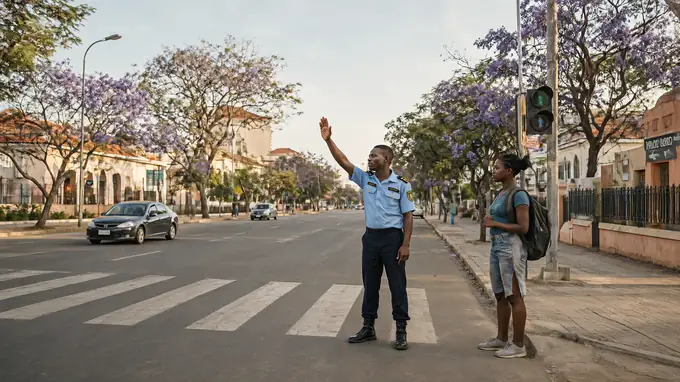
Before learning the rules, you need to speak the language of the Code. Article 1 points us to a glossary, Annex I, which holds the words that come up in the exams.
Think of the EN1 on the way out of Maputo: the asphalt where the cars and chapas (minibus taxis) drive is the carriageway. The strip of dirt or asphalt beside it, where many people pull over when a tyre bursts, is the hard shoulder. In town, the raised part beside the road where people walk is the pavement.
The rule
The carriageway is the part of the road made for vehicles to drive on.
What the Code says (art. 1, n.º Anexo I, al. m))
«Faixa de rodagem – parte da via pública especialmente destinada ao trânsito de veículos» (Portuguese original)
The rule
The hard shoulder runs alongside the carriageway and is not made for vehicles to drive on.
What the Code says (art. 1, n.º Anexo I, al. c))
«Berma – superfície de via pública não especialmente destinada ao trânsito de veículos e que ladeia a faixa de rodagem» (Portuguese original)
The rule
The pavement is only for pedestrians.
What the Code says (art. 1, n.º Anexo I, al. w))
«Passeio – parte que ladeia a faixa de rodagem, destinada exclusivamente ao trânsito de peões» (Portuguese original)

The rule
Stopping means halting only for as long as needed for people to get in or out, or for quick loading or unloading.
What the Code says (art. 1, n.º Anexo I, al. t))
«Paragem – imobilização de um veículo pelo tempo estritamente necessário para a entrada ou saída de passageiros ou para breves operações de carga ou descarga» (Portuguese original)
The rule
Seating capacity counts the passengers the vehicle can carry, and the driver counts too.
What the Code says (art. 1, n.º Anexo I, al. p))
«Lotação – número de passageiros que o veículo pode transportar, incluindo o condutor» (Portuguese original)
Remember
- Carriageway = part of the road for vehicles.
- Hard shoulder = beside the carriageway, not made for driving on.
- Pavement = for pedestrians only.
- Seating capacity includes the driver.
- Unladen weight = weight of the empty vehicle; gross weight = unladen weight + the load it can carry.

Check what you've learnt
2 quick questions. Choose and see straight away if you got it right.
A five-seater car has a seating capacity of five. How many passengers can it carry besides the driver?
Question 1See the answer
A — Seating capacity includes the driver, so four seats are left (art. 1, Annex I, subparagraph (p)).
What is the part that runs alongside the carriageway and is exclusively for pedestrians called?
Question 2See the answer
B — The pavement is intended exclusively for pedestrian traffic (art. 1, Annex I, subparagraph (w)).