
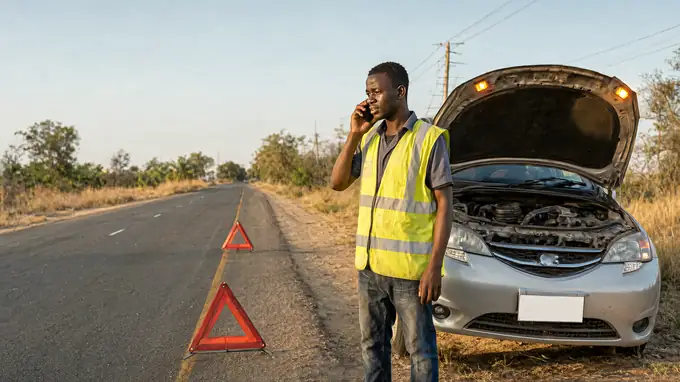
The triangle is not just for dramatic emergencies. There are clear rules about when it is compulsory, and they change between day and night. Always ask yourself the same question: can people coming from behind see my car, or the load that has fallen, in good time?
The rule
By day, the triangle is compulsory whenever the car stopped on the carriageway (or the fallen load) cannot be seen from at least 100 m.
What the Code says (art. 91, n.º 2)
«Durante o dia, sempre que o veículo imobilizado, total ou parcialmente, na faixa de rodagem ou a carga que tenha caído sobre o pavimento não for visível a uma distância de, pelo menos, 100 m;» (Portuguese original)
The rule
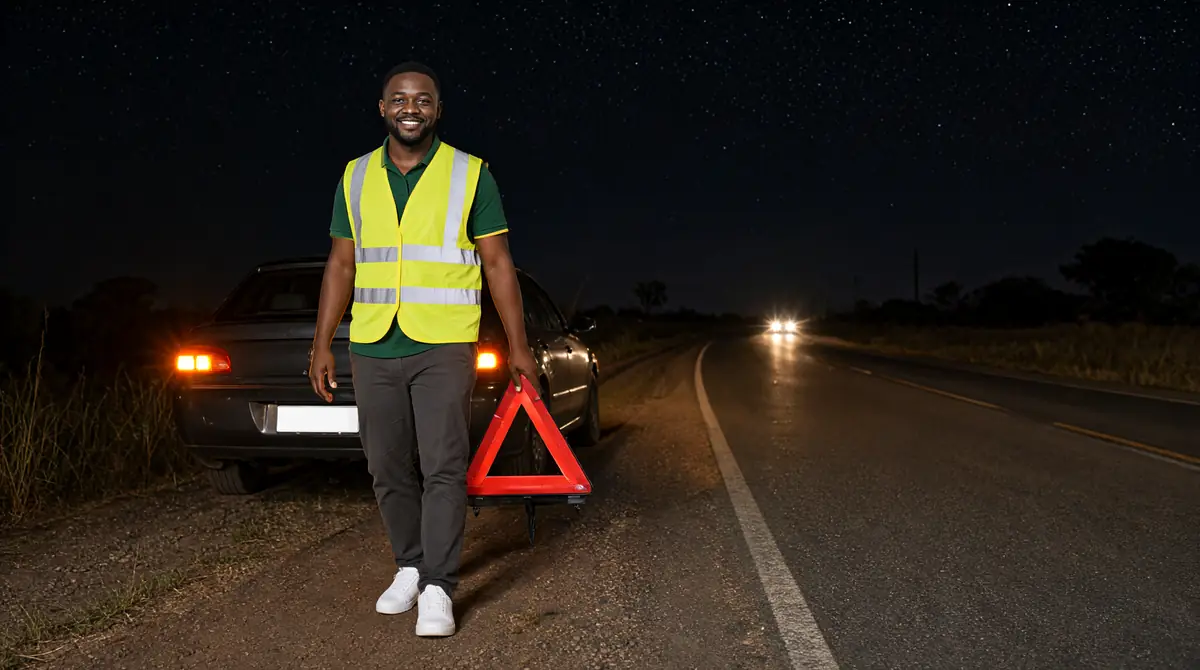
From dusk to dawn, it is compulsory whenever you stop on the carriageway or the hard shoulder, except where the lighting lets the car be seen clearly from 100 m.
What the Code says (art. 91, n.º 2)
«Do anoitecer ao amanhecer, em quaisquer circunstâncias de imobilização do veículo ou de carga caída na faixa de rodagem ou na berma» (Portuguese original)
The rule
Inside built-up areas, if the triangle cannot be placed, switch on all your indicators at the same time.
What the Code says (art. 91, n.º 2)
«No interior das localidades e nas situações em que a colocação do triângulo de pré-sinalização não seja viável, o veículo avariado deve ser sinalizado com o uso em simultâneo de todas as luzes indicadoras de mudança de direcção.» (Portuguese original)
The rule
Not using the triangle and the hazard warning lights is a serious offence.
What the Code says (art. 147, n.º 1)
«w) A não utilização do sinal de pré-sinalização de perigo e das luzes avisadoras de perigo.» (Portuguese original)
Remember
- Day: triangle if the car or the load cannot be seen from 100 m.
- Night: triangle whenever you stop on the carriageway or hard shoulder (unless it is well lit).
- In a built-up area with no room for the triangle: all indicators on.
- Not signalling = serious offence.

Check what you've learnt
2 quick questions. Choose and see straight away if you got it right.
It is 21:00 and your car has broken down on the hard shoulder of an unlit road. The triangle is:
Question 1See the answer
A — From dusk to dawn, it is compulsory whenever you stop on the carriageway or the hard shoulder (art. 91(2)(b)).
On a narrow city street it is not possible to place the triangle. How do you signal the broken-down car?
Question 2See the answer
B — Inside built-up areas, when the triangle is not feasible, all the indicators are used at the same time (art. 91(2)(c)).